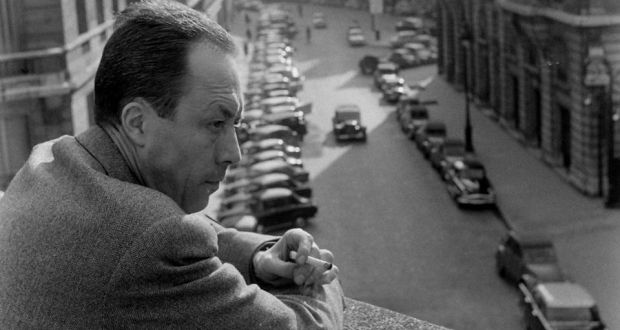
Camus on the Losses Inherent in Wealth

“What I mean is this: that one can, with no romanticism, feel nostalgic for lost poverty. A certain number of years lived without money are enough to create a whole sensibility. In this particular case, the strange feeling which the son has for his mother constitutes his whole sensibility. The latent material memory which he has of childhood (a glue that has stuck to his soul) explains why this way of feeling shows itself in the most widely differing fields.

Whoever notices this in himself feels gratitude and, consequently, a guilty conscience. If he has moved into a different class, the comparison also gives him the feeling that he has lost great wealth. For rich people, the sky is just an extra, a gift of nature. The poor, on the other hand, can see it as it really is: an infinite grace.”

Albert Camus, Notebooks 1935-1942

Wealth and poverty seem to be the heart of American politics. Indeed, the American dream itself asks us to leave one in pursuit of the other. But in recent times championing that dream has become controversial because maybe, for some people, that dream is impossible.

Thus, it becomes necessary to make sense of the situation. I can think of no better authority on wealth and poverty than Camus who grew up in a fatherless and most destitute home. What he offers us is this:

Maybe, we should not let wealth occupy every fiber of our existence. Maybe it is not as significant as we make it out to be. In fact, maybe it is only significant in the sensibility one will lose in being rich. Hard times make a person whole.

I would be interested to hear your thoughts. Thanks.

Socrates on his Sentence

“The hour of departure has arrived, and we go our separate ways – I to die, and you to live. Which is better God only knows.”

Socrates in Plato’s “Apology”

For this post, I offer Socrates’ final utterance and perhaps the most stoic depiction of death. Do you believe it has only been drawn up so admirably by Plato?

Personally, I would not doubt that Socrates acted so stoically. For additional commentary on “Apology” I direct you to this video where I first found this work and was inspired to read it.

To read “Apology,” I recommend using the following link where you may read it for free: http://classics.mit.edu/Plato/apology.html

The text itself is only approximately 32 pages in any regularly sized book.

Camus on the Novel as the Best Vessel for Philosophy

“People can only think in images. If you want to be a philosopher, write novels.”

Albert Camus, Notebooks I (1935-1942)
Image result for greek war ship pottery

Albert Camus wrote these words in one of his personal journals and how fortunate we are that they were published posthumously.

Unbelievably, there was once a time when I pondered what the relevance of philosophy was to literature. Naturally, it followed soon enough that I learned the purpose of the novel: to not only philosophize, but to demonstrate it (there could be another conversation here but for the sake of brevity). In its demonstration, one might immediately assume that Camus is correct, that the novel is the best vessel for philosophy.

Yet, years later, I can envision many angles to the conversation. For instance, we might consider the straightforwardness of a purely philosophical text. There is something to be admired in the author who puts it bluntly and quickly. For an engineer, such a text might be far superior to the longwinded and ambiguous novel. Still, beauty and demonstration might be worth the energy.

Furthermore, looking back on this note from 2021, I am ripe to say that the film or television series may be the best place for philosophy. I have seen Kubrick pack more than a novel into an image and writers such as Nic Pizzolatto consider television the most accessible and engaging place to philosophize. Indeed, you are sure to meet disappointment hoping your novel or blog will inspire a generation today.

I’d be interested to hear your thoughts.

Another thanks to the Albert Camus Facebook which, as I understand Camus more, becomes all the more brilliant. It is well moderated with wonderful excerpts and images and I highly recommend it to anyone.

https://www.facebook.com/AlbertCamusAuthor/

Seneca on Slavery

“I propose to value [slaves] according to their character, not their jobs. Each man has a character of his own choosing; it is chance or fate that decides his choice of job.

‘He’s a slave.’ But he may have the spirit of a free man. ‘He’s a slave.’ But is that really to count against him? Show me a man who isn’t a slave; one is a slave to sex, another to money, another to ambition; all are slaves to hope or fear. I could show you a man who has been a consul who is a slave to his ‘little old woman,’ a millionaire who is the slave of a little girl in domestic service…And there’s no state of slavery more disgraceful than one which is self-imposed.”

Letter XLVII to Lucilius

Seneca was an early and avid opponent of slavery in Ancient Rome or, at the very least, a proponent of the fair treatment of slaves. Here, in a testament to the humanity of ancient authors, he appeals to the question of free will and fortune in order to expose the injustice of the cruel treatment of slaves. What is truly miraculous is that one might argue the Romans treated their slaves far better than the slave owning states since that empire fell. Yet, Seneca’s humanism shines through in defense.

But we shouldn’t neglect his commentary on self-imposed slavery. You might reflect on whether or not you have committed yourself to a state of slavery. Do you endlessly pursue money or the affections of others? Is that the state you wish to consign yourself to?

Thanks.

Seneca on the Superiority of Man over the gods

“Would you like to know what the actual difference between you and the gods will be? They will exist for longer. And yet to me what an indisputable mark it is of a great artist to have captured everything in a tiny compass; a wise man has as much scope before him as a god with all eternity in front of him.”

Letter LIII to Lucilius

Remarking on the breadth of wisdom and brevity of life, Seneca offers Lucilius some consolation: for humanity, dust in the wind though we may be, any fragment of wisdom is a miracle and a testament to our fortitude. Perhaps we ought to be looking down on such hacks as the gods’ perpetuity. It is an emboldening statement for an aspiring philosopher.

Caesar responding to Ariovistus

“The immortal gods usually allow those men they wish to punish for their crimes a time of success and a period of impunity, so that when a change of fortune comes they are all the more grieved by it.”

Gaius Julius Caesar, The First Book: 58 BC, The Gallic War
Image result for julius caesar and ariovistus painting
Caesar and Ariovistus at their first Parlay

Recalling his response when German King Ariovistus boasted of the 107 BC victory over the Romans, Caesar informs his readers that he retorted something to the effect of the above. In light of the fact that the battle Ariovistus flaunts was one in which Caesar’s relative Lucius Piso and the Roman consul Lucius Cassius Longinus perished, this response reveals Caesar’s calm and collected wit. As Caesar then went on to rout the Germans back across the Rhine in a humiliating defeat, this quote reads almost like a prophecy. But one should read Caesar’s histories skeptically as he no doubt wrote them looking to heighten his own status and popularity. Indeed, the Gallic War was published on the eve of the civil war and retrospectively rendering himself as a prophet might assure submission.

I want to offer a thanks to the YouTube channel linked below where I was pointed to Caesar’s histories:

https://www.youtube.com/channel/UCv_vLHiWVBh_FR9vbeuiY-A

Seneca on Fortune

“What fortune has made yours is not your own.”

-Letter VIII to Lucilius

Roman philosopher Seneca here reminds Lucilius of a sentiment he earlier expressed. Fortune, in its abitrary forces, plays a massive role in the lives we lead. If we are a society that values the individual above the family and work ethic above all else, then perhaps fortune ought to be a lens through which we view and regard our merits. I find this quotation especially relevant considering the recent corruption we have found in our universities’ admissions offices. The scheming seems all the more pitiable when one accounts for the fact that many of the individuals admitted under unfair circumstances come from places of affluence. 


Seneca quoting Ovid on Wealth

“The poor man ’tis that counts his flock.”

Ovid, Metamorphoses, XIII: 824 qtd. in Letter XXXIII to Lucilius

In his letter to the aspiring stoic Lucilius, Seneca calls on the above verse by Ovid to offer some wisdom. Wealth and poverty, according to Seneca, are states defined by one’s perception…not one’s possessions. The poor man may be wealthy with a fraction or none of the wealthy man’s possessions, if only he makes little requisite to his happiness. This optimistic notion promises man a life of felicity no matter his fortune, and challenges all of us to redefine our necessities.

For this post I’d like to offer thanks to the following page and YouTube channel where my interest in Seneca first came to light:

https://orwell1627.wordpress.com/about/

https://www.youtube.com/user/TheRuggedPyrrhus

In addition to finding Seneca through this creator, I’ve appropriated the words and concept of “The Great Conversation” from him.  I am proud to be a part of it.

Camus on Nationalism

“I love my country too much to be a nationalist.”

Albert Camus, letters to a German friend (1945)

I find Camus’ stance on nationalism quite compelling. Too often nationalism manifests itself dogmatically…in a form which can do nothing but stomp out positive and necessary change. One may love their country and not be a nationalist.

A thanks again to the facebook page linked below, where I came across this excerpt of Camus’

https://m.facebook.com/AlbertCamusAuthor/

Camus on Lifting Others

Image result for albert camus color image
Always with cigarette in hand

“We help a person more by giving him a favorable image of himself rather than constantly reminding him of his shortages.”

-Albert Camus, Notebooks 1942-1951

For my first post, I think it fitting to offer this wisdom from celebrated French-Algerian philosopher and Nobel laureate, Albert Camus. Reflecting on those first English papers I received back that brandished marks of encouragement, I doubt I would have began pursuing wisdom in my free time, and thus doubt this page would be possible, if not for the fire that was ignited in me when I read them.

A special thanks to the facebook page linked below where I found this excerpt.

https://m.facebook.com/AlbertCamusAuthor/