Reel Rookie: Art, Film, and “Barry Lyndon”

“The test of a work of art is, in the end our affection for it, not our ability to explain why it is good.”

Stanley Kubrick

Criticizing, comparing, and understanding the infinitely complicated children of a genius is not an easy task, let alone the children of two geniuses. And so here I am on a Saturday, two weeks after a careful reading of William M. Thackeray’s novel, The Memoirs of Barry Lyndon, Esq., unsure what to write. So here I am on a Saturday, after a dozen viewings of Kubrick’s film Barry Lyndon, one of my all-time favorites, unsure what to write. I am not qualified to tell you about the technical marvels of the film, nor am I an actor or photographer. And still, as a writer, it is not easy to tell you what the novel has in store. But Kubrick really throws me a bone with that quote, “Just do your best,” he seems to be saying. And so I will, even if it comes down to stating my simple affections.

I think it is best to start this week’s review where the film began, with the novel. A dusty old Oxford World Classic, one might see the iconic white stripe on the cover, remembering that some horribly boring poetic dialogue they read in high school belonged to the same banner. But it shouldn’t be judged as such for it’s actually terribly approachable and entertaining like much writing of the same time period.

And believe me, like anyone, I was once intimidated by the ridiculous language, silly costumes, hideous makeup, and stern rules of those centuries; I suppose, until I was forced to read of them. What I found then was that I had been missing out on a miracle: two hundred years later we’re hilariously similar. Thackeray’s characters use the term “I O U” and love gambling, drinking, drama, and sex just like the rest of us. Mozart was into flatulent humor. Perhaps the industrial centuries are where we should draw the line between the humanity of old and new because it’s just too easy to see this novel played out today. Many of my old assumptions turned out to be false too. There is hardly any language barrier and the costumes are no more ridiculous than what you would see on the red carpet.

So I have no choice after that rant I guess, at the risk of greatly underestimating a critically acclaimed novel, but to try and sum it up. While Thackeray, according to the back cover, viewed the “true art of fiction” as “[representing] a subject, however unpleasant, with accuracy and wit, and not [moralizing],” you’re very likely to read it as a Christian novel. Peasant Redmond Barry, the protagonist and narrator, is far removed from the Irish gentry but clings onto the idea of his high birth. Barry’s pride, ambition, greed, adultery, and boldness takes him through several intense pistol duals, the seven years war, and to the top of every European court. The same qualities also become his tragic downfall as he tries to obtain a title of nobility and struggles to gain the affections of his snobbish pain-in-the-ass stepson, Lord Bullingdon. So you see, it’s pretty likely to read as some sort of Christian admonition or a novel of the seven deadly sins, like Crime and Punishment.

But Thackeray really does leave you to judge the moral of the novel. Indeed, it cannot be ignored that the protagonist is far from a Christian and all events are retold through his justification and narration. What’s sure though, is that by the end I was affected by the humor and grief and was glad to have it in my library.

Now, I’m sure by this point you are ripe to know how my tirade ties into the movie. Well, I am reminded of something Seneca wrote to Lucilius,

What an indisputable mark it is of a great artist to have captured everything in a tiny compass

Seneca, Letter LIII to Lucilius

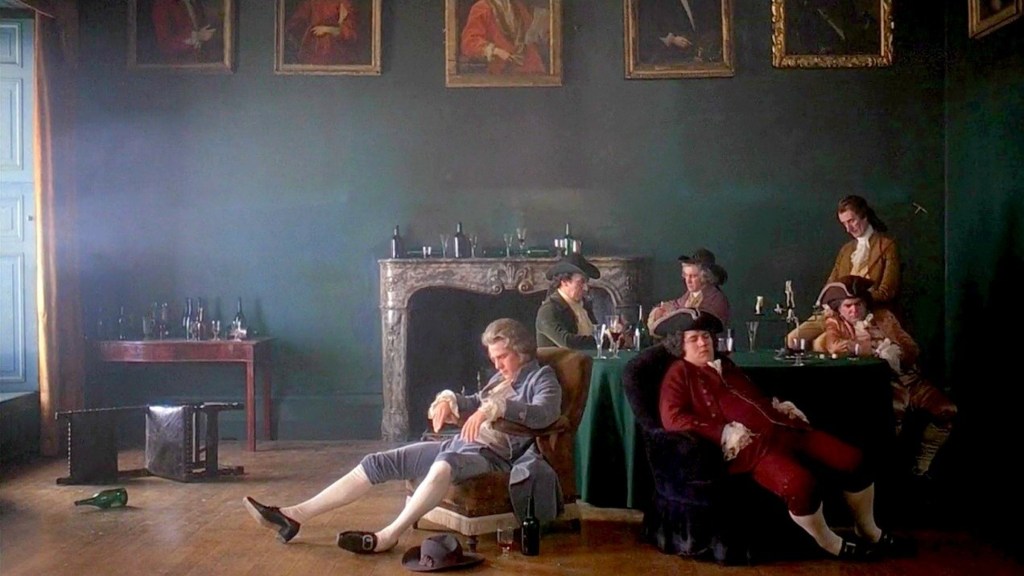
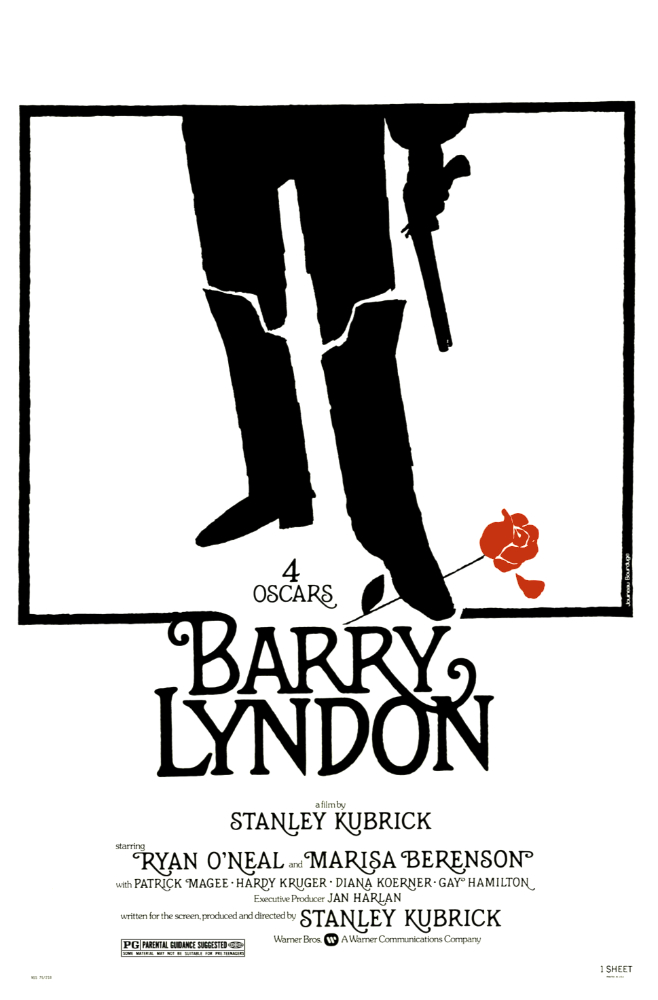
If the novel isn’t for you, the film surely is. Few people want to sit down and painstakingly read a novel they have no stake in (unless you’re a huge Kubrick and Barry Lyndon fan like me). As that fan, I will tell you that Kubrick makes the novel even more approachable and faithfully captures just about all of it in his compass. I mean every bit of dialogue is taken directly from the book and there seems to be hardly a piece of that novel missing. Yet, how much more the beautiful set pieces, camerawork, and acting represent than ten novels ever could. For all that, it feels like this movie is highly underrated and forgotten. Upon its release it won 4 Oscars, but today Kubrick is more well known as a skilled adapter for 2001, The Shining, and A Clockwork Orange. He ought to be remembered by this.

I have heard three YouTube essayists call the film a collection of renaissance paintings. Let’s not forget that it is also an entire novel and, like those other adaptations, a testament to the flexibility of the movie as a medium. It is infinitely inspiring and all for less time and money than a paperback oxford world classic. If you want to see the full potential of film, I love this work of art and I hope you will too.

Precious Registers: a Story…or Elegy…of Chess

“You thought that everything could be expressed with figures, formulas ! But when you were compiling your precious registers, you quite forgot the wild roses in the hedges, the signs in the sky, the smiles of summer, the great voice of the sea, the moments when man rises in his wrath and scatters all before him. […] Even when you are flushed with victory, defeat is knocking at your door. For there is in man an innate power that you will never vanquish, a gay madness born of mingled fear and courage, unreasoning yet victorious through all time. One day this power will surge up and you will learn that all your glory is but dust before the wind”.

Albert Camus, The State of Siege (1948)

Just as there are two armies on the board, black and white, there are two schools of thought when it comes to the categorization of chess: there are those who think it of the heart and, indeed, art…and then there are those those who see it as a science. But which side is victorious, if either, that is for you to decide.

The two army officers sat across from each other and before an ancient set of pieces in a rundown pub in St. Petersburg. They had been cadets there just a year before at the engineering college.

The first, Dmitri, was a disgruntled and sloppy officer. But in chess the rookie was a bit more cleaned up. Always trying new things, on some days he could force a beautiful checkmate with the right blend of vodka, insanity, and heart for this new game. He sat up straight, smirking, and enjoying his cigarette.

The other, Fyodor, was a straight arrow of an officer. He had been playing for years without idealism, always committed to the books and masters. The more consistent of the two players was hunched over, resting his chin on his fist, already calculating what his fifth move would be.

They were good friends but the latter had been somewhat of a chess instructor to the former for several weeks, and they had experienced their first division over the same.

You see, Dmitri was not easy to instruct. Unlike his professor, he was far too impulsive, or perhaps was too proud or drunk, to ever be keen on calculating more than a few moves or coming up with anything other than a general plan of attack.”

“E4?” Fyodor asked with a grin as Dmitri posted his first pawn, “The start of a textbook opening, maybe?”

Dmitri paused and responded with an air of secrecy “It’s unoriginal, I know…but not in the sense you think.”

“How so?”

With the grin of a child offering some smart mouth remark, and playing D4, Dmitri retorted, “Well, if I told you I’d certainly be beat.”

But it couldn’t have been more than four moves before he had to explain his undefended pawns in the center of the board, and, indeed, before Fyodor had obviously taken the upper hand.

“Alright.” Dmitri began, seeing his plan foil before his eyes, “I’ll tell you. You see, the game is somewhat of a metaphor for life, no? At least a metaphor for war? Well, since it’s so, I figured I could apply one of sly Hannibal’s tricks from Cannae. You see here how I exaggerate the weakness of my center, ready to envelop you once you take the bait?”

Fyodor looked up from the board, confusion and disappointment on his face.

“Well, you know it’s high risk and reward. It could end well for me.”

With a deep breath, veteran Fyodor did his best not to ramble on, “You’re more the Romans in that position than the Carthaginians. It’s not a real war. It’s an algorithm and you might want to play the book moves. Most of them are even vetted by the computers. You’ve heard news of the computers abroad and what they can do? Forget about their computers, what our computers have to say. Besides, if the game’s like any war, it’s some impersonal war of the future.”

“Using precious bandwidth to test chess moves? Here? In Russia?!”

“It’s quite a piece of propaganda you know, being the winner. Even Kasparov and Karpov like to use them to test positions.”

“Well, there’s little honor or spirit in that is there?” Dmitri asked sulking.

“Well, if everyone uses them? What do you do when your opponent brings cavalry to the battle? Bring your own, no?”

“Sure, but the Romans didn’t bring elephants to Zama. They outplayed them.”

“Soon enough, there won’t be outplaying a computer” Fyodor smartly retorted as he forked Dmitri’s king and rook.

Dmitri knocked over his king and shook hands with Fyodor. They sat in silence for a moment collecting their pieces. As Dmitri finished setting up his side, he grabbed some of Fyodor’s pieces to help him and began laughing, filling the immediate area with the smell of vodka, “They’ve even found a way to take the blood out of chess have they?”

“Right, for the players to some extent. But the best nation still wins. We are the ones who program the computers aren’t we?”

“As a soldier and gentlemen,” both grinned at that, “I wouldn’t have an engineer taking my plunder or trophy.”

“Fair enough. But remember there won’t be many trophies if you don’t study up on the computers. And forget the computers. You ought to read up on some literature at least to avoid blunders like that. You can borrow some of my books or I can show you.”

“I’m good.” Dmitri replied unsurprisingly, taking a long pause afterwards. “Scipio was born out of a great blunder, you know?”

“Pardon?”

“Scipio, he was one of only a few who escaped Cannae.”

“I wasn’t aware he was in that battle. I thought all the Romans had been slaughtered.”

“No, he was one of a dozen young men who made it out and, as you well know, beat Hannibal at Zama. He beat him against insurmountable odds too. Just what Rome needed after losing some 25% of their military-aged male population at Cannae. You realize how insane that is?” Dmitri asked in awe. “The Krauts capitulated after losing 5% in the First World War? For my part, a miracle of will like that is proof enough humanity will never be completely passed up by an algorithm.”

With a smile on his face, Fyodor obliged the drunk, “And for my part, I didn’t know it was possible to sound like Vodka. Come on, give me that piece so we can play again.”

“Just one win is a testament to the human spirit!”

Fyodor laughed, putting his last piece in position for battle, “Alright Scipio, only time will tell, huh?”

Dedicated to my friend and master in chess, Hunter