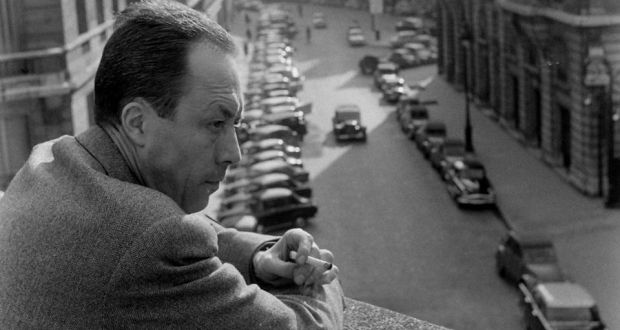
Camus on the Losses Inherent in Wealth

“What I mean is this: that one can, with no romanticism, feel nostalgic for lost poverty. A certain number of years lived without money are enough to create a whole sensibility. In this particular case, the strange feeling which the son has for his mother constitutes his whole sensibility. The latent material memory which he has of childhood (a glue that has stuck to his soul) explains why this way of feeling shows itself in the most widely differing fields.

Whoever notices this in himself feels gratitude and, consequently, a guilty conscience. If he has moved into a different class, the comparison also gives him the feeling that he has lost great wealth. For rich people, the sky is just an extra, a gift of nature. The poor, on the other hand, can see it as it really is: an infinite grace.”

Albert Camus, Notebooks 1935-1942

Wealth and poverty seem to be the heart of American politics. Indeed, the American dream itself asks us to leave one in pursuit of the other. But in recent times championing that dream has become controversial because maybe, for some people, that dream is impossible.

Thus, it becomes necessary to make sense of the situation. I can think of no better authority on wealth and poverty than Camus who grew up in a fatherless and most destitute home. What he offers us is this:

Maybe, we should not let wealth occupy every fiber of our existence. Maybe it is not as significant as we make it out to be. In fact, maybe it is only significant in the sensibility one will lose in being rich. Hard times make a person whole.

I would be interested to hear your thoughts. Thanks.

Camus on the Novel as the Best Vessel for Philosophy

“People can only think in images. If you want to be a philosopher, write novels.”

Albert Camus, Notebooks I (1935-1942)
Image result for greek war ship pottery

Albert Camus wrote these words in one of his personal journals and how fortunate we are that they were published posthumously.

Unbelievably, there was once a time when I pondered what the relevance of philosophy was to literature. Naturally, it followed soon enough that I learned the purpose of the novel: to not only philosophize, but to demonstrate it (there could be another conversation here but for the sake of brevity). In its demonstration, one might immediately assume that Camus is correct, that the novel is the best vessel for philosophy.

Yet, years later, I can envision many angles to the conversation. For instance, we might consider the straightforwardness of a purely philosophical text. There is something to be admired in the author who puts it bluntly and quickly. For an engineer, such a text might be far superior to the longwinded and ambiguous novel. Still, beauty and demonstration might be worth the energy.

Furthermore, looking back on this note from 2021, I am ripe to say that the film or television series may be the best place for philosophy. I have seen Kubrick pack more than a novel into an image and writers such as Nic Pizzolatto consider television the most accessible and engaging place to philosophize. Indeed, you are sure to meet disappointment hoping your novel or blog will inspire a generation today.

I’d be interested to hear your thoughts.

Another thanks to the Albert Camus Facebook which, as I understand Camus more, becomes all the more brilliant. It is well moderated with wonderful excerpts and images and I highly recommend it to anyone.

https://www.facebook.com/AlbertCamusAuthor/

Camus on Nationalism

“I love my country too much to be a nationalist.”

Albert Camus, letters to a German friend (1945)

I find Camus’ stance on nationalism quite compelling. Too often nationalism manifests itself dogmatically…in a form which can do nothing but stomp out positive and necessary change. One may love their country and not be a nationalist.

A thanks again to the facebook page linked below, where I came across this excerpt of Camus’

https://m.facebook.com/AlbertCamusAuthor/

Camus on Lifting Others

Image result for albert camus color image
Always with cigarette in hand

“We help a person more by giving him a favorable image of himself rather than constantly reminding him of his shortages.”

-Albert Camus, Notebooks 1942-1951

For my first post, I think it fitting to offer this wisdom from celebrated French-Algerian philosopher and Nobel laureate, Albert Camus. Reflecting on those first English papers I received back that brandished marks of encouragement, I doubt I would have began pursuing wisdom in my free time, and thus doubt this page would be possible, if not for the fire that was ignited in me when I read them.

A special thanks to the facebook page linked below where I found this excerpt.

https://m.facebook.com/AlbertCamusAuthor/