Letter V to Alex: A Humbled Prayer from East of Eden

Alex,

I have been thinking further on the losses inherent in impiety. Do you ever lament that certain things were not sown into you as a child? Take the belief in the soul, the afterlife, and deity. It seems, at random, the gardener gently waters some by those beliefs to full bloom while others are condemned to remain small seeds, unsure and afraid of even the soil that has borne them. You see, how much anxiety would have been spared me were I always to have attended church?

With the philosophical pain that has charged my veins, I might pridefully conjure up a comparison to Socrates’ allegory. But we must recall that only the enslaved claim exaltation. I won’t deny though, be it my shackles or the blinding light, much of life has felt an aching purgatory…nihilism creeping over the horizon some mornings instead of our lofty sun.

Still, the sun also rises beyond paradise. When you lose a friend and mentor of such magnitude that you must get down on your knees and say a prayer, you break through a set of definite chains…those of self-pity….and feel the grace of the gardener.

Always cherish your friends and family.

Regards,

Liber
Letter IV to Alex: On Original Work, Organic Thought, and Collective Unconscious

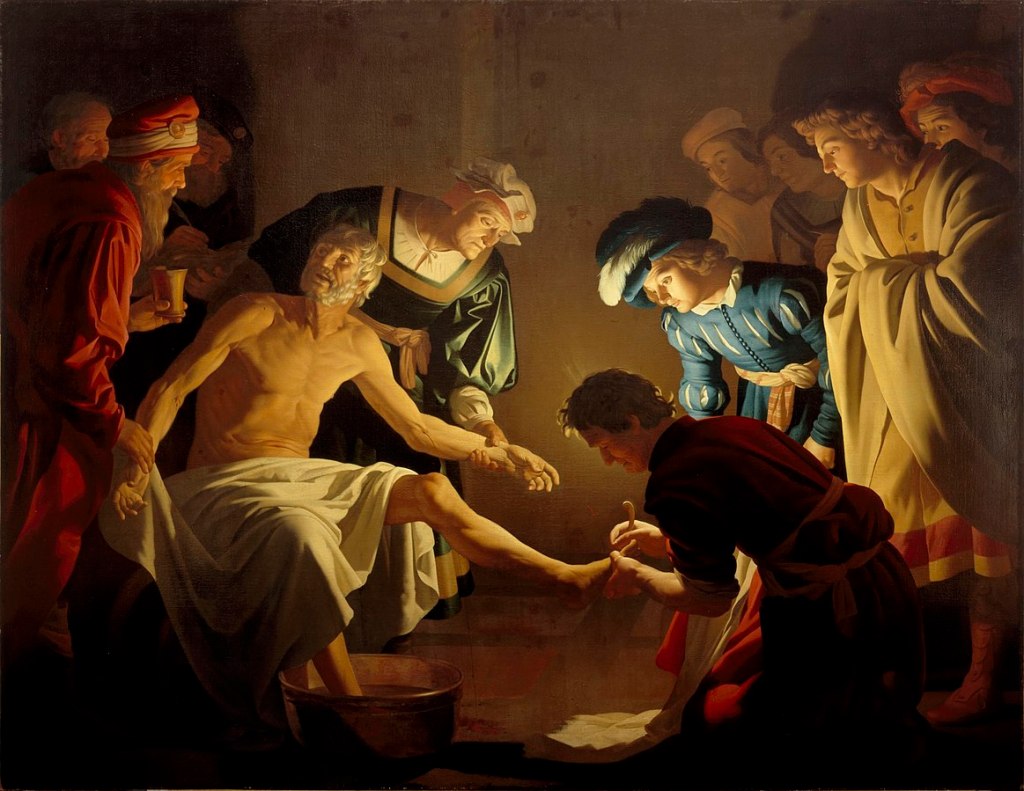
Gerard van Honthorst’s “The Death of Seneca”

Alex,

So there is already quite a bit of writing on the philosophy of video games then? It is always disappointing when you believe you have something original–a potential article or thesis–and you find someone beat you to it. When the idea came to you organically, that is…without any knowledge that it already existed, you are likely to be so distraught as to craft conspiracies that someone traveled to the future and stole it from you. So it was when I found so many of my organic ideas unoriginal.

There is an optimistic angle to those situations though. It’s important to compare yourself to those at the top of the podium and realize whatever metal you wear is not much less worthy than theirs. Silver and bronze are not worth much less than gold. And you must not forget that you ran the same course to the same conclusion that they did. If you did not fare well on this one, on this day, perhaps you will fare better on the next course, on the next day.

But so many of us racing the same track? Perhaps this common predicament is a testament to collective unconscious and the lunacy of “organic ideas” and “original work.” Perhaps it is a testament that the truth lies dormant in all of us just waiting for the right catalyst to bring it up to the surface. In that sense, there is no race to be had but for false medals. Certainly this was Seneca’s thought when he reminded us the truth belongs to no one.

Regards,

Liber

Letter I to Alex: On People, STEM, and the Humanities

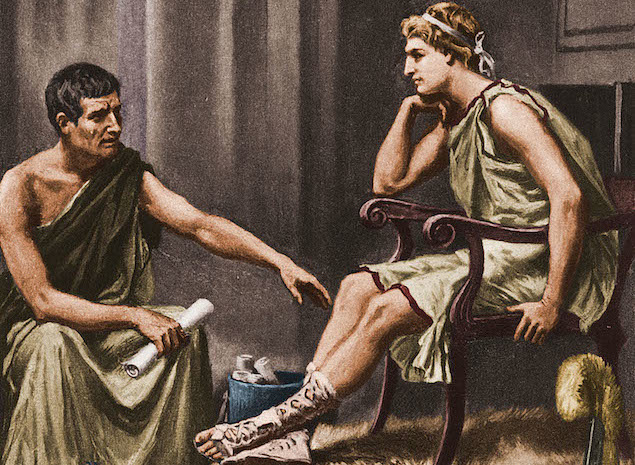
Aristotle tutoring Alexander by Jean Leon Gerome Ferris, 1895

Alex,

You have sought what I hope to be a just counsel regarding the role of the sexes in academia and, specifically, the humanities. It has been the subject of my conscience often and has occupied my subconscious since I first put pen to paper. So in due course, I hope to set you off well.

So they will call Alex a woman for writing poetry and essays in his journal? For reading Shakespeare and Tacitus? Well, recall to them that Alexander the Great was no stranger to strong words when he penned cowardly Darius. Remind them that Alexander neither fretted in the power of persuasion before the mutineers, nor strayed far from his tutor Aristotle as a boy. The same could be said of Caesar who read of Alexander and Grant who read of Caesar’s tears.

And if they should really be so backwards to think that power is what makes a man, remind them that it was no engineer who started the French Revolution; or, if it were, it was the “softer side” of their brain that played both fuse and fire for that monumental event. But why should we segregate such things to begin with? It’s the humanities, after all.

You see, your generation has before you a chance to correct not one, but two great missteps. For one, it would take a great philosopher and historian to explain what is at fault but the issue persists: somehow or other, men are fleeing the humanities at large since this last century and women have taken it up. Yet today, we hear that we need more women in STEM and, for my part, I will say we need more men in the humanities.

Most certain on this topic, though, is the root misstep. We began only with the renaissance man and regressed even from that. What notion is there of the renaissance man or renaissance woman today? Men should neglect neither half of their brains, nor should women for that matter. Remember, we were fools to think things would be for the better if we ignored the education of our daughters. Let us not allow invisible divisions to cast that mistake on both our daughters and sons.

My regards,

Liber