I figured I would share some movies I just recently watched. You see, I haven’t felt motivated to watch something new in a couple months. But suddenly, my old passion for film stood over my shoulder and I decided not just to watch something new, but some older black and white films I had yet to see. That was especially strange to me because I have greatly admired some black and whites but would never choose them over something in color. I guess that’s worthy of documentation these days. Here they are.
The Killing by Stanley Kubrick – At only an hour and twenty minutes, you won’t endure pain for too long if you hate it but I doubt you will. For being near seventy years old, it feels as fast paced and modern as a Tarantino flick. And come on, it’s mobsters trying to rob the track. I was disappointed to think that only Scorsese and Coppola made mob flicks. But Kubrick too?
Sunset Boulevard by Billy Wilder – I thought Mulholland Drive was the only great film named after a street in LA. It was good to see that it’s not, especially considering my fascination with the city skyline I could see on a clear spring evening as a boy. As far as the film, it’s a movie lover’s movie, much like Mulholland Drive. You can get a taste for the Hollywood of DeMille’s era, if it ever ended, as the protagonist struggles through his relationship with a washed up silent film actress of the good ole’ days. But don’t worry. It’s not a silent film itself and should still be of interest to the person who doesn’t love movies (though I have yet to meet someone who doesn’t). For now, know that Sunset Boulevard makes enough noise. Its dark turns can keep your eyes glued to a black and white screen.
Citizen Kane by Orson Welles – Geez, I thought I was making a mistake putting this one off for so long. But its story is a tragedy of such proportion that I now wish I had never watched it. “Rosebud” is enough to bring a tear to anybody’s eye. No, seriously, this film in all its glamor and glory will put you down for at least the rest of the day. Once you pick yourself up though, you will recall it with only the utmost respect. Not even considering that it was released the same year Pearl Harbor was bombed, this is a true standout in all film and art. Follow Kane who leaves his family’s destitute life in Colorado to be a truly affluent man…only to slowly devolve into a shallow existence.
“The test of a work of art is, in the end our affection for it, not our ability to explain why it is good.”
Stanley Kubrick
Criticizing, comparing, and understanding the infinitely complicated children of a genius is not an easy task, let alone the children of two geniuses. And so here I am on a Saturday, two weeks after a careful reading of William M. Thackeray’s novel, The Memoirs of Barry Lyndon, Esq.,unsure what to write. So here I am on a Saturday, after a dozen viewings of Kubrick’s filmBarry Lyndon, one of my all-time favorites, unsure what to write. I am not qualified to tell you about the technical marvels of the film, nor am I an actor or photographer. And still, as a writer, it is not easy to tell you what the novel has in store. But Kubrick really throws me a bone with that quote, “Just do your best,” he seems to be saying. And so I will, even if it comes down to stating my simple affections.
I think it is best to start this week’s review where the film began, with the novel. A dusty old Oxford World Classic, one might see the iconic white stripe on the cover, remembering that some horribly boring poetic dialogue they read in high school belonged to the same banner. But it shouldn’t be judged as such for it’s actually terribly approachable and entertaining like much writing of the same time period.
And believe me, like anyone, I was once intimidated by the ridiculous language, silly costumes, hideous makeup, and stern rules of those centuries; I suppose, until I was forced to read of them. What I found then was that I had been missing out on a miracle: two hundred years later we’re hilariously similar. Thackeray’s characters use the term “I O U” and love gambling, drinking, drama, and sex just like the rest of us. Mozart was into flatulent humor. Perhaps the industrial centuries are where we should draw the line between the humanity of old and new because it’s just too easy to see this novel played out today. Many of my old assumptions turned out to be false too. There is hardly any language barrier and the costumes are no more ridiculous than what you would see on the red carpet.
So I have no choice after that rant I guess, at the risk of greatly underestimating a critically acclaimed novel, but to try and sum it up. While Thackeray, according to the back cover, viewed the “true art of fiction” as “[representing] a subject, however unpleasant, with accuracy and wit, and not [moralizing],” you’re very likely to read it as a Christian novel. Peasant Redmond Barry, the protagonist and narrator, is far removed from the Irish gentry but clings onto the idea of his high birth. Barry’s pride, ambition, greed, adultery, and boldness takes him through several intense pistol duals, the seven years war, and to the top of every European court. The same qualities also become his tragic downfall as he tries to obtain a title of nobility and struggles to gain the affections of his snobbish pain-in-the-ass stepson, Lord Bullingdon. So you see, it’s pretty likely to read as some sort of Christian admonition or a novel of the seven deadly sins, like Crime and Punishment.
But Thackeray really does leave you to judge the moral of the novel. Indeed, it cannot be ignored that the protagonist is far from a Christian and all events are retold through his justification and narration. What’s sure though, is that by the end I was affected by the humor and grief and was glad to have it in my library.
Now, I’m sure by this point you are ripe to know how my tirade ties into the movie. Well, I am reminded of something Seneca wrote to Lucilius,
“What an indisputable mark it is of a great artist to have captured everything in a tiny compass“
Seneca, Letter LIII to Lucilius
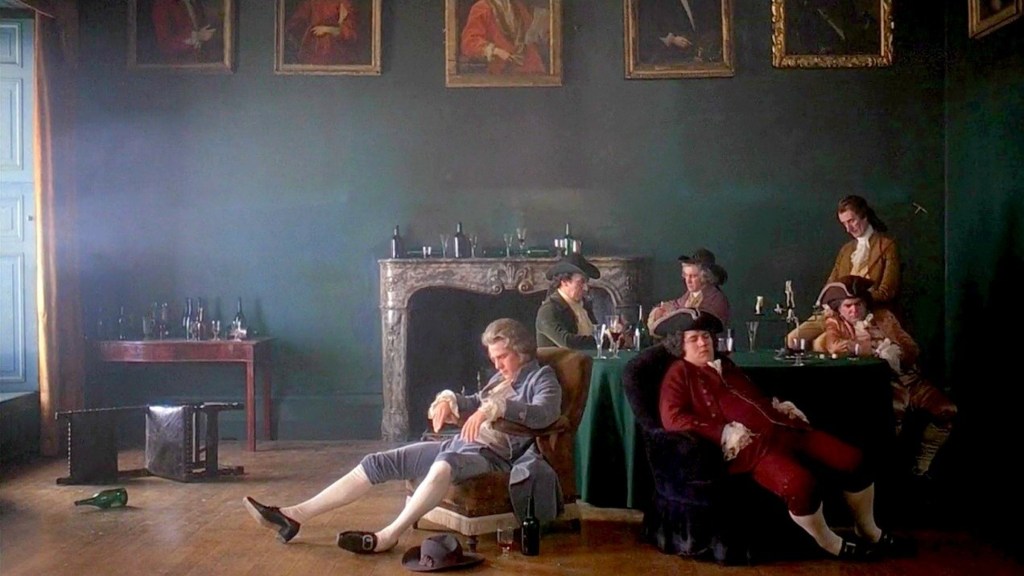
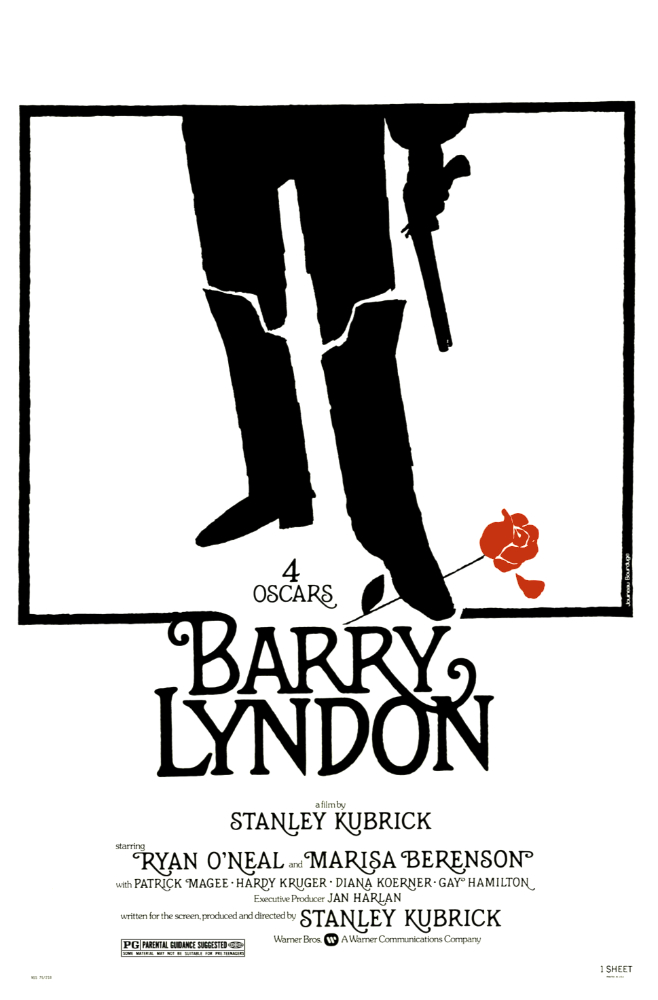
If the novel isn’t for you, the film surely is. Few people want to sit down and painstakingly read a novel they have no stake in (unless you’re a huge Kubrick and Barry Lyndon fan like me). As that fan, I will tell you that Kubrick makes the novel even more approachable and faithfully captures just about all of it in his compass. I mean every bit of dialogue is taken directly from the book and there seems to be hardly a piece of that novel missing. Yet, how much more the beautiful set pieces, camerawork, and acting represent than ten novels ever could. For all that, it feels like this movie is highly underrated and forgotten. Upon its release it won 4 Oscars, but today Kubrick is more well known as a skilled adapter for 2001, The Shining, and A Clockwork Orange. He ought to be remembered by this.
I have heard three YouTube essayists call the film a collection of renaissance paintings. Let’s not forget that it is also an entire novel and, like those other adaptations, a testament to the flexibility of the movie as a medium. It is infinitely inspiring and all for less time and money than a paperback oxford world classic. If you want to see the full potential of film, I love this work of art and I hope you will too.



 Luke's Blog