How could I review In Bruges without mention of the bewitching poem it features, “On Raglan Road” by Patrick Kavanagh?
I have somewhat of a love/hate relationship with poetry. In a sense, I find myself at opposition with the stringent rules and regulation that define so much of poetry. I think art should not be governed, but be governor. At the same time, perhaps I am just too lazy to learn and respect them. Undeniably though, the well structured “On Raglan Road” is one of the most beautiful tunes I’ve read and listened to and casts Ireland as an enchanted place of poetry. If you don’t like reading poetry, Luke Kelly’s cover from the film is most compelling and is embedded below.
Kavanagh and Kelly actually met at the Bailey Pub in Dublin. Kavanagh, with embarrassment, asked Kelly to cover his poem about a girl run away. Kelly did…and with much dignity.
On Raglan Road on an autumn day I saw her first and knew That her dark hair would weave a snare that I might one day rue; I saw the danger, yet I passed along the enchanted way, And I said, let grief be a fallen leaf at the dawning of the day.
On Grafton Street in November we tripped lightly along the ledge Of the deep ravine where can be seen the worth of passion’s pledge, The Queen of Hearts still making tarts and I not making hay Oh I loved too much and by such by such is happiness thrown away.
I gave her gifts of the mind I gave her the secret sign that’s known To the artists who have known the true gods of sound and stone And word and tint without stint for I gave her poems to say. With her own name there and her own dark hair like clouds over fields of May
On a quiet street where old ghosts meet I see her walking now Away from me so hurriedly my reason must allow That I had loved not as I should a creature made of clay When the angel woos the clay he’d lose his wings at the dawn of day.
Patrick Kavanagh
An interview with Kelly followed by “On Raglan Road”
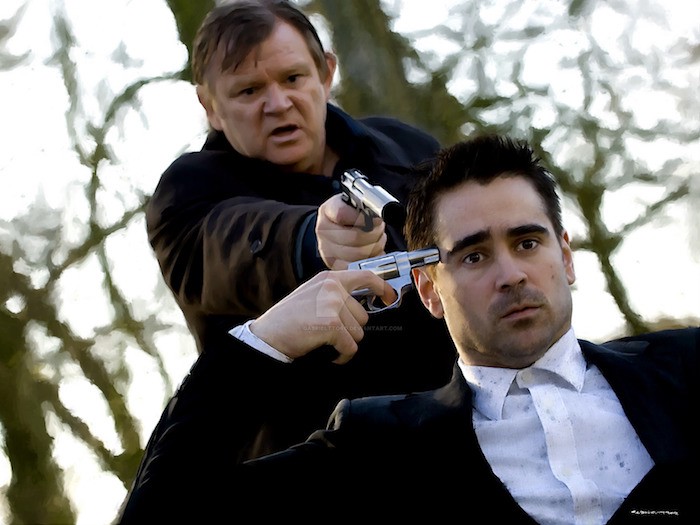
As far as its usage in the film, I think it is quite self-evident. Kavanagh talks of his unrequited love, a sacrifice. Ken makes his own poetic sacrifice for Ray.
**I love Quentin Tarantino. Believe me, my goal was not to criticize him.**
?
An Unholy Comparison
Last week, a colleague expressed his serious disdain of Quentin Tarantino. I had no idea people hated Tarantino. But, unknown to my friend, like so many supposed film “afficionados,” Tarantino was my world for a while. As the youngster with two film classes under my belt, I even committed myself to watching his entire anthology. But looking back through the hundred or so films that have graced me in the years since, Tarantino no longer sits atop the same pedestal on which I once placed him; or, at the very least, I no longer stand by to berate all who despise him.
I still adore his work and his idiosyncrasies of course, but a director has creeped into my life that I cannot help but adore just as well and maybe even offer up as an alternative to Tarantino. Indeed, some people need an alternative. They hate those Tarantino idiosyncrasies: his use of temporal disjunction, slow—sometimes snoring—pace (how many 2.5 – 3 hour movies can this guy put out?), and his insistence on hyper exaggerated violence. Martin McDonagh, thus far, has not demonstrated any of those most hated marks. Further, while I cannot put my finger on why save for the directors’ crossover in dark comedy, McDonagh seems to manifest some of the most agreeable aspects of a Tarantino flick.
Having seen McDonagh’s dark comedy In Brugesthe most, I will here try and convince you it is a good starting point if Tarantino threatens you.
Plot and Analysis
Compared to something like Pulp Fiction, the plot is simple and almost completely linear: aging mafia hitman Ken (Brendan Gleeson) and his childish apprentice Ray (hilarious Colin Farrell), are sent to the “fairytale” town Bruges, Belgium after a job in London goes awry. Specifically, after Ray kills a young boy by mistake.
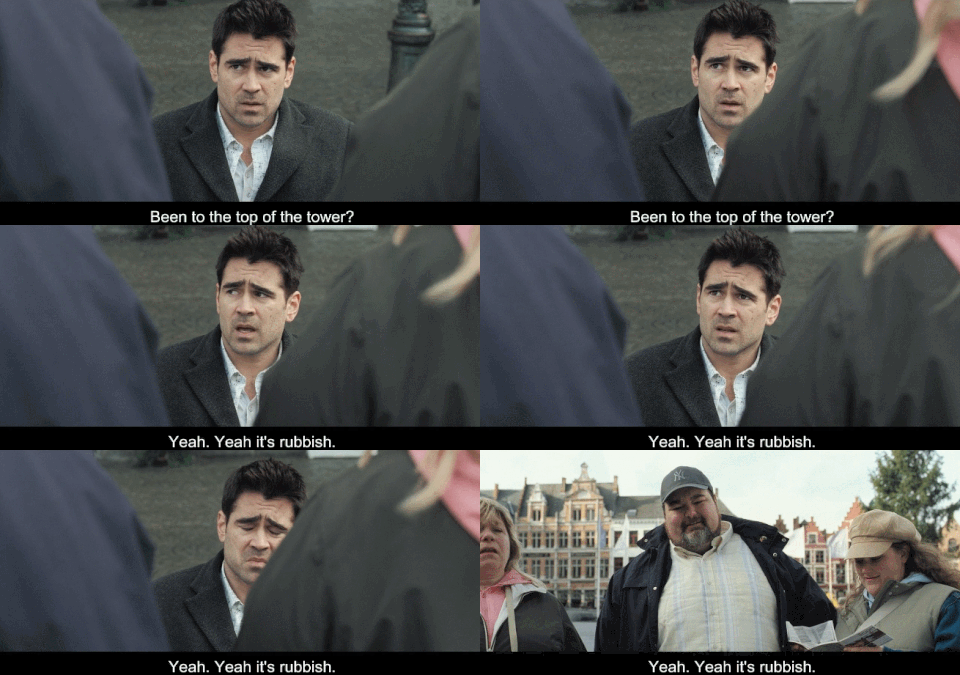
While Ken wants to ride the tourist pony show seeing the inside of every castle and waiting in queue for all the churches like any senior citizen, Ray “throws a fucking moody,” as they say on the other side of the pond, through all of it. For Dublin-born Ray, his opinion of the town and sightseeing is obvious even before he makes it clear,
“If I grew up on a farm, and was retarded, Bruges might impress me. But I didn’t, so it doesn’t!”
Still worse for Ken’s holiday, he is made to play the role of a father when Ray’s guilt-ridden conscience turns suicidal.
Through all their hilarious back and forth about whether to get pissed at the pub or go see another church, a dark turn blindsides the viewer. The boss orders Ken to kill Ray for the collateral damage. Softened since his younger days and thinking himself a father-figure to Ray, a moral dilemma follows for Ken: to carry on with the inflexible and vengeful rule that dictates mafia life or believe in life and change.
Hilarity ensues but therein is the philosophy as well. The boss’s call is perhaps the epicenter of the serious questions posed by McDonagh: does it make any sense for ever-changing man to adopt a rigid morality? Does it make any sense for imperfect man to be so hell-bent on justice and vindication? These clear uncertainties are especially refreshing coming from a Tarantino film which does not simply pose a question through dialogue or action, but itself embodies postmodernist philosophies.
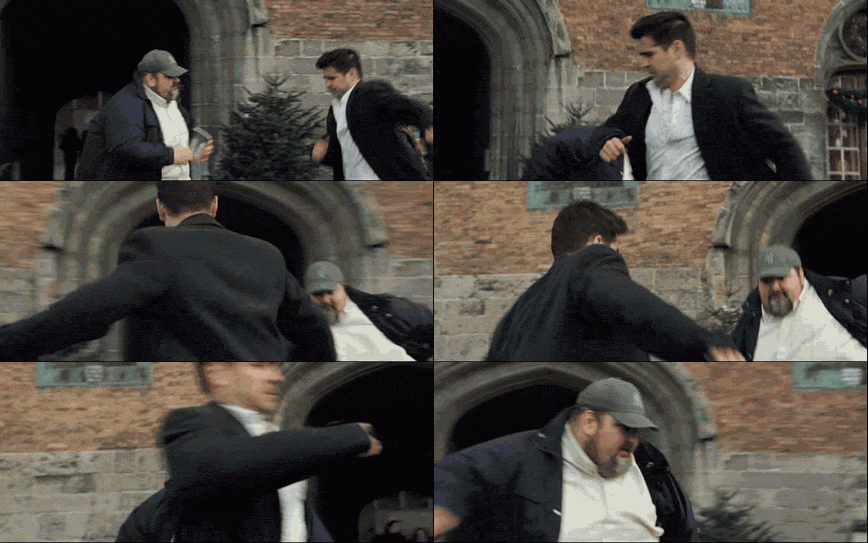
In many other ways, McDonagh is welcome coming down from a Tarantino high. His use of violence, for instance, is more modest and does not flirt with suspension of disbelief. Naturally, there are a few fist fights and the film culminates in a spectacular foot chase through Bruges’ Christmastime streets. Still, rest assured. No one gets killed with a flamethrower or a can of dog food like in Tarantino’s recent Once Upon a Time in Hollywood.
Further, the lack of the problematic Hollywood badass (think Cliff Booth from that movie or Lt Aldo Raine from Inglourious Basterds) also makes the film less immersion breaking. Compared to the unbelievable cool factor of Tarantino’s roles, Ray and Ken are outrageously human. They are not mere hitmen. They eat light yogurt, might wear the same shirt for three days straight, and might not know what an alcove is. I cannot remember the last time I could recall such everyday human details about a character.
So, you see, In Brugesavoids the most polarizing parts of Tarantino and still does action and dark comedy in style. Moreover, McDonagh deals in some of the serious philosophical questions of generations. For that, I can give In Brugesmy highly sought-after Reel Rookie seal of approval and recommend it to you. For my part and for the sake of comedy, I hope McDonagh’s string of successes made up of In Bruges, Three Billboards, and Seven Psychopaths is never ending.



 Luke's Blog