Letter IV to Alex: On Original Work, Organic Thought, and Collective Unconscious

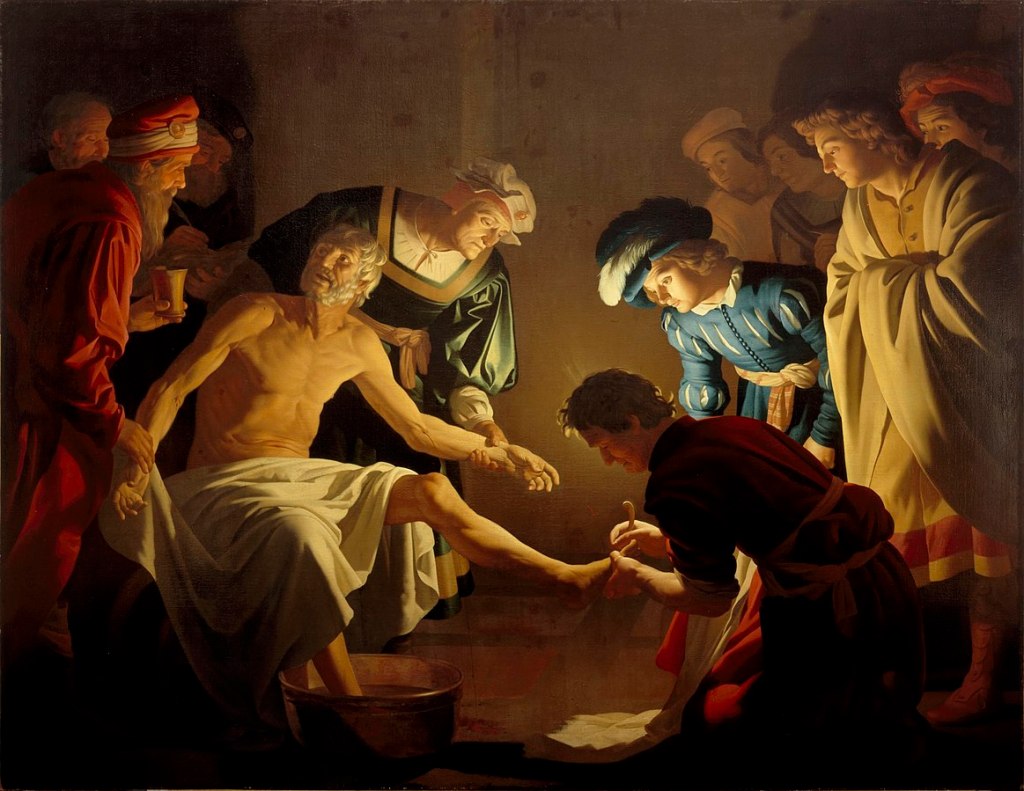
Gerard van Honthorst’s “The Death of Seneca”

Alex,

So there is already quite a bit of writing on the philosophy of video games then? It is always disappointing when you believe you have something original–a potential article or thesis–and you find someone beat you to it. When the idea came to you organically, that is…without any knowledge that it already existed, you are likely to be so distraught as to craft conspiracies that someone traveled to the future and stole it from you. So it was when I found so many of my organic ideas unoriginal.

There is an optimistic angle to those situations though. It’s important to compare yourself to those at the top of the podium and realize whatever metal you wear is not much less worthy than theirs. Silver and bronze are not worth much less than gold. And you must not forget that you ran the same course to the same conclusion that they did. If you did not fare well on this one, on this day, perhaps you will fare better on the next course, on the next day.

But so many of us racing the same track? Perhaps this common predicament is a testament to collective unconscious and the lunacy of “organic ideas” and “original work.” Perhaps it is a testament that the truth lies dormant in all of us just waiting for the right catalyst to bring it up to the surface. In that sense, there is no race to be had but for false medals. Certainly this was Seneca’s thought when he reminded us the truth belongs to no one.

Regards,

Liber
Letter I to Alex: On People, STEM, and the Humanities

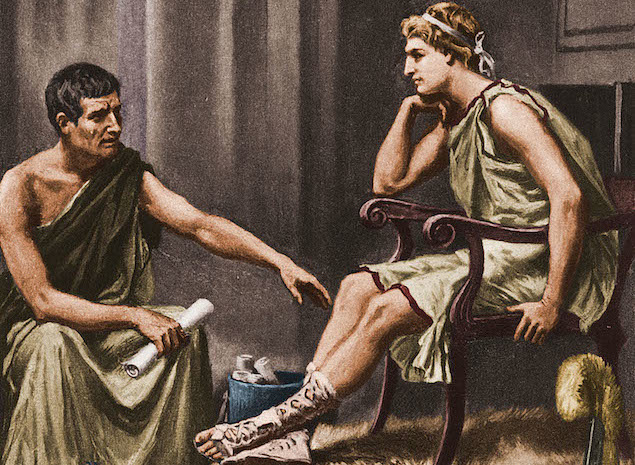
Aristotle tutoring Alexander by Jean Leon Gerome Ferris, 1895

Alex,

You have sought what I hope to be a just counsel regarding the role of the sexes in academia and, specifically, the humanities. It has been the subject of my conscience often and has occupied my subconscious since I first put pen to paper. So in due course, I hope to set you off well.

So they will call Alex a woman for writing poetry and essays in his journal? For reading Shakespeare and Tacitus? Well, recall to them that Alexander the Great was no stranger to strong words when he penned cowardly Darius. Remind them that Alexander neither fretted in the power of persuasion before the mutineers, nor strayed far from his tutor Aristotle as a boy. The same could be said of Caesar who read of Alexander and Grant who read of Caesar’s tears.

And if they should really be so backwards to think that power is what makes a man, remind them that it was no engineer who started the French Revolution; or, if it were, it was the “softer side” of their brain that played both fuse and fire for that monumental event. But why should we segregate such things to begin with? It’s the humanities, after all.

You see, your generation has before you a chance to correct not one, but two great missteps. For one, it would take a great philosopher and historian to explain what is at fault but the issue persists: somehow or other, men are fleeing the humanities at large since this last century and women have taken it up. Yet today, we hear that we need more women in STEM and, for my part, I will say we need more men in the humanities.

Most certain on this topic, though, is the root misstep. We began only with the renaissance man and regressed even from that. What notion is there of the renaissance man or renaissance woman today? Men should neglect neither half of their brains, nor should women for that matter. Remember, we were fools to think things would be for the better if we ignored the education of our daughters. Let us not allow invisible divisions to cast that mistake on both our daughters and sons.

My regards,

Liber

Seneca on Slavery

“I propose to value [slaves] according to their character, not their jobs. Each man has a character of his own choosing; it is chance or fate that decides his choice of job.

‘He’s a slave.’ But he may have the spirit of a free man. ‘He’s a slave.’ But is that really to count against him? Show me a man who isn’t a slave; one is a slave to sex, another to money, another to ambition; all are slaves to hope or fear. I could show you a man who has been a consul who is a slave to his ‘little old woman,’ a millionaire who is the slave of a little girl in domestic service…And there’s no state of slavery more disgraceful than one which is self-imposed.”

Letter XLVII to Lucilius

Seneca was an early and avid opponent of slavery in Ancient Rome or, at the very least, a proponent of the fair treatment of slaves. Here, in a testament to the humanity of ancient authors, he appeals to the question of free will and fortune in order to expose the injustice of the cruel treatment of slaves. What is truly miraculous is that one might argue the Romans treated their slaves far better than the slave owning states since that empire fell. Yet, Seneca’s humanism shines through in defense.

But we shouldn’t neglect his commentary on self-imposed slavery. You might reflect on whether or not you have committed yourself to a state of slavery. Do you endlessly pursue money or the affections of others? Is that the state you wish to consign yourself to?

Thanks.

Seneca on the Superiority of Man over the gods

“Would you like to know what the actual difference between you and the gods will be? They will exist for longer. And yet to me what an indisputable mark it is of a great artist to have captured everything in a tiny compass; a wise man has as much scope before him as a god with all eternity in front of him.”

Letter LIII to Lucilius

Remarking on the breadth of wisdom and brevity of life, Seneca offers Lucilius some consolation: for humanity, dust in the wind though we may be, any fragment of wisdom is a miracle and a testament to our fortitude. Perhaps we ought to be looking down on such hacks as the gods’ perpetuity. It is an emboldening statement for an aspiring philosopher.

Seneca on Fortune

“What fortune has made yours is not your own.”

-Letter VIII to Lucilius

Roman philosopher Seneca here reminds Lucilius of a sentiment he earlier expressed. Fortune, in its abitrary forces, plays a massive role in the lives we lead. If we are a society that values the individual above the family and work ethic above all else, then perhaps fortune ought to be a lens through which we view and regard our merits. I find this quotation especially relevant considering the recent corruption we have found in our universities’ admissions offices. The scheming seems all the more pitiable when one accounts for the fact that many of the individuals admitted under unfair circumstances come from places of affluence. 


Seneca quoting Ovid on Wealth

“The poor man ’tis that counts his flock.”

Ovid, Metamorphoses, XIII: 824 qtd. in Letter XXXIII to Lucilius

In his letter to the aspiring stoic Lucilius, Seneca calls on the above verse by Ovid to offer some wisdom. Wealth and poverty, according to Seneca, are states defined by one’s perception…not one’s possessions. The poor man may be wealthy with a fraction or none of the wealthy man’s possessions, if only he makes little requisite to his happiness. This optimistic notion promises man a life of felicity no matter his fortune, and challenges all of us to redefine our necessities.

For this post I’d like to offer thanks to the following page and YouTube channel where my interest in Seneca first came to light:

https://orwell1627.wordpress.com/about/

https://www.youtube.com/user/TheRuggedPyrrhus

In addition to finding Seneca through this creator, I’ve appropriated the words and concept of “The Great Conversation” from him.  I am proud to be a part of it.